Fiber Laser Welding Guide: Process, Fit-Up and Power Selection
By Brad Cairns
Published
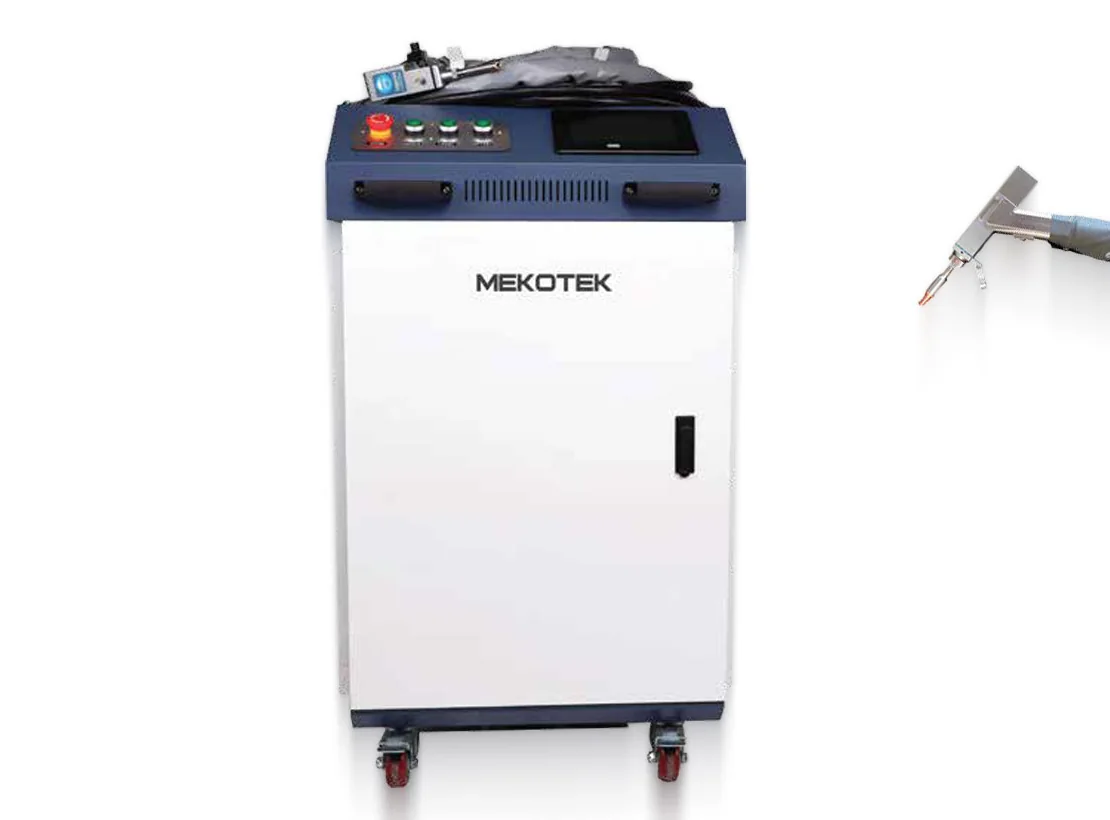
A handheld fiber laser welder joins metal by focusing a beam onto the seam while the operator travels the joint by hand, much as they would with a MIG or TIG torch. The resemblance in handling ends there. The heat source is a fraction of the width of an arc, the heat-affected zone is narrower, and the process tolerates less variation in joint fit-up than arc welding does. Deciding whether it belongs in a shop means weighing that tradeoff against your actual parts and joints, not against a general claim that laser welding is simply better.
How the heat differs from MIG and TIG
An arc distributes heat over a wider area of the joint and surrounding base metal, which is part of why MIG and TIG can bridge modest gaps and absorb some fit-up variation — the arc and filler metal fill the space. A laser beam concentrates energy into a small spot, producing a narrower melt pool and a correspondingly narrower heat-affected zone. Less heat spread into the surrounding material generally means less thermal distortion on thin sheet, and a smaller weld bead that in many cases needs less post-weld grinding or finishing to reach a presentable surface. Whether that holds on your specific material, thickness and joint design is worth confirming with a trial weld rather than assumed from the general principle.
Fit-up and fixturing: the real prerequisite
The narrow beam that gives laser welding its advantages also removes the arc's tolerance for gaps. A MIG weld can often bridge a joint gap with extra filler wire; a laser beam aimed at a gap wider than its focused spot will not reliably bridge it, because the process depends on the beam finding continuous base metal to melt into. This makes joint fit-up and fixturing the real qualifying question for any part being considered for laser welding:
- Parts must be cut, formed and fixtured so the joint faces meet consistently along the full seam length, not just at a few tack points.
- Fixturing needs to hold that fit-up rigidly through the full weld pass, since even minor movement during the pass can open a gap the beam cannot bridge.
- Parts coming off a laser cutter or press brake with tight, repeatable tolerances are better candidates than parts hand-fitted from stock, because laser-cut and accurately formed edges are more likely to mate consistently without manual dressing.
If your current fixturing routinely relies on the welder to close small gaps with extra filler passes, that habit has to change before laser welding will perform as expected on the same parts.
Joint design choices that make or break the process
Fit-up is a function of joint design as much as cutting or forming accuracy, and some joint types are inherently easier to qualify for laser welding than others:
- Butt joints demand the tightest gap control of any joint type, because there is no overlap of base metal to absorb a mismatch. Butt joints on laser-cut edges that mate squarely are strong candidates; butt joints on sheared or hand-trimmed edges are not, without added dressing.
- Lap joints are more forgiving, since the overlap gives the beam continuous base metal to work into even if the parts are not perfectly square to each other. Many shops moving from arc to laser welding start with lap joints for this reason.
- Corner and edge joints on formed sheet metal enclosures are common laser-welding applications because a press brake can hold the fit-up tolerance the process needs, provided the bend sequence and tooling are dialled in first.
- Fillet welds on structural tube or profile depend on how square and consistent the cut ends and copes are; a tube laser cutting the joint faces removes one source of fit-up variation that a saw-and-fit process would otherwise introduce.
Reviewing joint type against your fixturing and cutting process before a trial saves time later — a joint design that requires hand-fitting to close a gap is a joint design that needs to change, not a laser welding problem to solve with more power.
Material and thickness considerations
Weldable thickness depends on the material and the laser power available. As a general principle across handheld fiber welding, thinner gauges and lower-reflectivity materials weld with less power than thicker sections or highly reflective metals such as aluminium and brass, which absorb energy less readily and need more power to achieve consistent penetration. Confirm the specific thickness range for your material against the specification sheet of the machine under consideration — do not assume a thickness figure quoted for one material or one power level applies to another.
Choosing a power level
Mekotek offers handheld fiber laser welders at three power levels — 1 kW, 1.5 kW and 2 kW — and the difference between them is capability on thicker or more reflective material, not a difference in the welding process itself:
- The 1 kW unit covers lighter stainless, carbon steel and aluminium/brass fabrication where material stays on the thinner end of the shop's mix.
- The 1.5 kW unit steps up penetration capability on the same material families, reaching further into stainless, carbon steel and aluminium/brass thickness than the 1 kW unit.
- The 2 kW unit is oriented toward aluminium and brass work specifically, plus heavier cleaning duty and light cutting from the same gun.
Match the power level to your thickest routine material in the alloy family you actually run — stainless, carbon steel or aluminium/brass — rather than to an average across your job mix, and confirm current thickness figures against the manufacturer's specification table for the model, since these figures are tied to a specific machine generation.
Welding, cleaning and cutting modes
Handheld fiber laser welding machines offer more than one mode from the same gun: welding, surface cleaning (removing rust, oxide or coating ahead of a weld pass), and light cutting. Which mode matters most for a given shop depends on the workflow — a shop that spends time prepping rusted or coated surfaces before welding may value the cleaning mode as much as the weld capability itself, while a shop running clean, laser-cut stock may use it only occasionally. Confirm which modes are available on a specific machine and power level before assuming a capability is included.
Operator skill transition from arc welding
An experienced MIG or TIG welder brings real, transferable skill to laser welding — joint reading, travel speed control, and an eye for weld quality — but the technique itself differs enough that it is not a same-day transition. Operators need time to adjust travel speed and gun angle to the narrower beam and smaller melt pool, and to unlearn habits (such as weaving to bridge a gap) that do not translate to a process with less gap tolerance. Budget for a supervised transition period on production parts rather than assuming an arc welder can run a laser welder at full rate immediately.
Building a training path, not a single session
Treat the move to laser welding as a staged skill transition rather than a one-time orientation on the equipment. A practical sequence:
- Equipment and hazard orientation. Beam path, interlocks, eyewear, enclosure operation and lockout procedures, covered before an operator ever strikes a weld — separate from welding technique itself.
- Bead-on-plate practice. Straight-line travel speed and gun-angle control on scrap stock of the shop's own material and thickness, before any production joint is attempted.
- Fixtured coupon welds. Practice joints built in the same fixturing the operator will use in production, so the skill being learned includes reading fit-up quality, not only torch control.
- Supervised production parts. Real parts run under supervision, with weld appearance and finishing time tracked against the shop's quality standard before the operator is signed off to run unsupervised.
- Ongoing calibration. Periodic review of weld quality and travel speed as material, thickness or joint design in the shop's mix changes, since a technique that was correct for one job may not transfer cleanly to the next.
How long each stage takes depends on the operator's prior arc-welding experience and the complexity of the shop's joints, and is a judgment the supervising welder or shop lead should make on the actual parts rather than on a fixed calendar.
Enclosure and workspace layout
Where the welding station sits on the floor, and what surrounds it, is a planning decision separate from the machine purchase itself. Considerations specific to laser welding include:
- Line of sight control. The beam path needs to be contained so it cannot reach other operators, foot traffic, or reflective surfaces that could redirect it. This shapes where the station can be placed relative to other work areas, not just how much floor space it occupies.
- Curtain or enclosure specification. Laser-rated barriers or curtains around a welding cell are a control measure whose specification depends on the beam class and power of the specific machine — confirm the requirement against the equipment's documentation and the applicable regulation, rather than reusing a barrier spec from an arc-welding booth.
- Access control. Limiting who can enter the enclosed area while the beam is active, and how that is enforced (interlocks, signage, restricted keys), is part of the workspace design and should be settled before the station is commissioned, not adjusted after an incident.
- Ventilation and extraction placement. Fume extraction still needs to reach the point of work regardless of process; laser welding does not remove that requirement, and enclosure design should route extraction so the fume is captured without disturbing beam containment.
Verify the specific enclosure and interlock requirements for the machine under consideration against its equipment documentation and the applicable regulation in your jurisdiction — these are not interchangeable across manufacturers or power levels.
Fume extraction and hazard control
Laser welding generates metal fume in the same general sense as arc welding, and extraction at the point of work is part of a safe setup regardless of process. Laser welding also introduces a distinct hazard category: the beam itself, which presents an eye and skin exposure risk beyond what an arc welding station requires controls for. Enclosure, beam containment and appropriate eyewear are process-specific control measures that should be verified against the actual equipment configuration and the applicable regulatory requirements in your jurisdiction, not assumed from arc-welding safety practice.
Running a qualification trial on your own joints
Before committing to laser welding for a production part, run a trial using your own material, your own fixturing and your own joint design — not a demonstration part supplied by a machine vendor. A useful trial checks:
- Whether your current fixturing achieves the fit-up the process needs, or whether tooling changes are required first
- Weld appearance and any post-weld finishing still needed compared with your current arc process
- Distortion on the actual part geometry, particularly on thin sheet or assemblies with long, unsupported spans
- Cycle time on the actual joint length and sequence, not a straight-line test coupon
Treat the trial as the qualifying step for the process on your parts, separate from the question of which power level or machine to purchase.
When cleaning or cutting modes matter more than welding
Because the same handheld gun can switch between welding, cleaning and light cutting modes, the buying decision is sometimes less about weld capability than about which mode dominates the shop's actual workload. A shop that spends significant time stripping rust, mill scale or old coating ahead of a weld pass may get as much value from the cleaning mode as from welding itself, since laser cleaning avoids the abrasive media and dust of grinding or blasting for that prep step. A shop doing occasional thin-material trim cuts alongside its welding work may lean on the light-cutting mode as a convenience rather than treat it as a full substitute for a dedicated cutting laser. Map your actual job mix across all three modes before assuming the purchase decision is a welding-only decision.
Post-weld finishing time as the metric that matters
The narrower heat-affected zone and smaller bead that laser welding produces are cited as an advantage, but the number worth tracking on your own parts is finishing time — minutes of grinding, blending or dressing per part or per metre of weld, before and after switching processes. A smaller bead does not automatically mean zero finishing; it means less finishing than the equivalent arc weld on the same joint, and the size of that difference depends on your quality standard, the visibility of the weld on the finished part, and the material. Track finishing time on trial parts as carefully as you track weld cycle time, since finishing labor is often the larger cost on cosmetic assemblies.
Sources
The following sources are cited for generic laser safety and health-hazard context only, not for any Mekotek product specification:
- OSHA, Laser Hazards
- OSHA, Occupational Health and Safety Technical Manual, Health Hazards
- CCOHS, Lasers — Health Effects
For the current Mekotek handheld fiber laser welding range, see laser welding machines.
Related equipment: Handheld fiber laser welders
See the machines behind the article
Browse the full Mekotek product brochure, or book a live demo and see a Mekotek handheld fiber laser welder run a bead on your own parts.
Related Articles
Tube Laser Cutting: Dedicated Machine or Sheet + Tube Combo
How round, square, rectangular and open-profile tube is cut on a laser, and how to decide between a dedicated tube machine and a sheet-plus-tube combo.
Material Handling Around a Laser: From Manual to Automated
The laser spends part of every shift waiting on metal to be moved, not cut. A stage-by-stage look at handling sheet and tube, and when automating it is justified.
What to Ask Before Putting a Laser Cutting Machine on Your Network
A buyer's question list for connecting production equipment: what data is worth collecting, who controls it, and how to keep the machine off the office network.