Material Handling Around a Laser: From Manual to Automated
By Brad Cairns
Published Updated
Every part that comes off a laser table has already been moved several times before the beam ever touches it, and it will be moved several more times before it leaves the building. Raw sheet or bar arrives, goes into storage, gets pulled and staged, gets loaded onto the table, gets cut, gets unloaded, gets sorted into finished parts and skeleton or drops, and the finished parts get staged for the next operation. None of that is cutting time. On a machine that is otherwise capable of running continuously, this is often where the available hours actually go — worth measuring on your own floor rather than assumed.
This article walks through the handling stages in order, the maturity levels a shop can move through as volume grows, what each level requires before it will work, and how to tell whether handling is the thing actually limiting output before spending money on it.
The handling stages
Raw stock storage. Sheet is stored flat, in racks or on the floor, sorted by grade and thickness. Tube and bar are stored in cantilever racks or bins, sorted by profile and length. Storage discipline — consistent labelling, one grade per location, no mixed-thickness stacks — determines how fast the next stage can happen and how often the wrong material gets pulled by mistake.
Presentation and staging. Before material reaches the machine it has to be identified, pulled, and staged close to the table in the order the job schedule calls for it. This step is invisible when it works and expensive when it doesn't: a missing sheet found after the program is loaded stops the machine, not the picker.
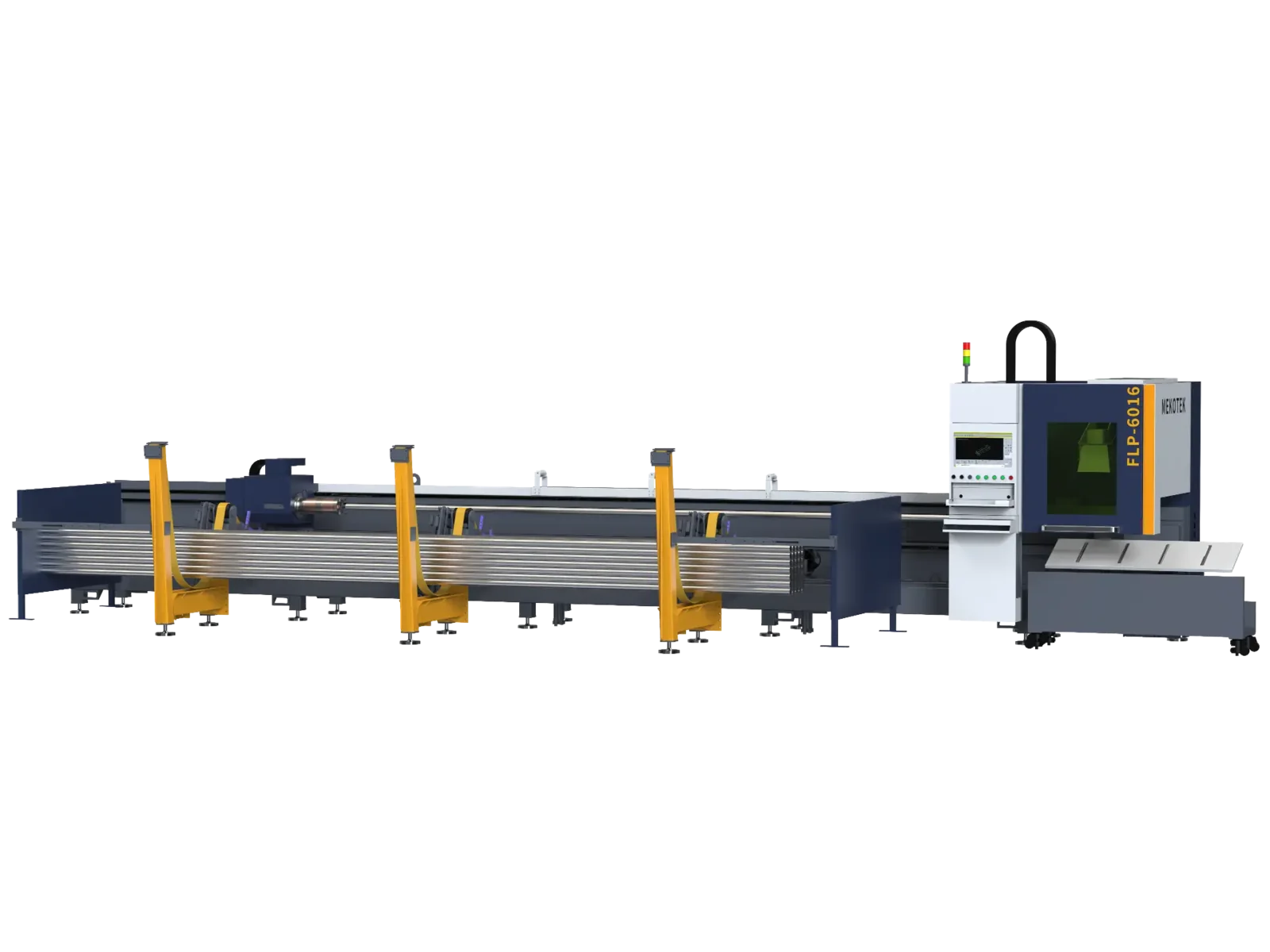
Loading. Getting the sheet or bar onto the table or into the tube chuck. On a sheet machine this is a crane, a vacuum lifter, or a forklift with forks or a sheet clamp. On a tube machine it is a bar being indexed into the chuck and loading tube, by hand, by an operator running a hoist, or by a magazine that feeds stock automatically.
Unloading. Cut parts and skeleton have to come off the table before the next sheet can go on, or off the tube saw-off point before the next length can advance. On sheet work this can be the slower of load/unload because parts have to be picked individually rather than lifted as one unit.
Part sortation. Small parts, especially from a dense nest, need to be separated, identified and routed — to a bin, a pallet, a kitting cart, or directly to the next operation. Sortation gets harder as nests get denser and part counts per sheet increase.
Scrap and skeleton removal. The skeleton left after a sheet is cut has to be lifted or conveyed off the table and out of the cell before the next sheet can be presented. Drops and grid-cut remnants need a place to go that keeps them identifiable and doesn't become a tripping or crush hazard.
Downstream staging. Finished parts move to inspection, deburring, bending or welding. Where this queue backs up, faster cutting or loading upstream just moves the pile rather than shortening the day.
The maturity ladder
Fully manual. An operator or a two-person team handles every step by hand or with a forklift and crane: fetch stock, load, run the cycle, unload, sort, clear skeleton, restage. This works at low-to-moderate volume and with varied job mix, because a person can adapt to whatever the next job requires without reprogramming anything. Its ceiling is set by how many load/unload cycles a person can physically do in a shift and how much of that time is walking rather than working.
Shuttle or dual tables. A second table lets the operator load and unload one table while the machine cuts on the other, then the tables exchange. This removes load/unload time from the cutting-time side of the ledger, but the operator still does every load and unload by hand — it changes when the work happens, not how much of it there is.
Semi-automatic loading. Some tube and profile machines offer a semi-automatic feed step: the operator loads a bar or a stack, and the machine indexes or advances stock through the cutting cycle with less manual intervention per part. This reduces touches per part but still needs an operator present to reload and to manage completed and remnant stock.
Automated feed and towers. At the top of the ladder, sheet storage towers or automatic loading systems present material to the table with minimal operator handling per cycle, and some tube configurations feed continuous stock through multiple cutting cycles before an operator has to intervene again. This is where handling stops scaling with headcount and starts scaling with uptime and program discipline instead.
Not every model in every family offers every rung of this ladder. Confirm what a specific machine supports — manual, semi-automatic, dual-table, or automated feed — against the current specification for that model rather than assuming a capability carries across the range.
What each step up requires
Moving up the ladder is not simply a purchase decision. Each step adds prerequisites that, if missing, turn the automation into an expensive bottleneck of its own.
- Floor space and ceiling height. Towers and automated feed systems have a footprint and a clear height requirement well beyond the machine itself. Measure the actual building, including columns, sprinkler heads, and crane rail height, before assuming a system fits.
- Material consistency. Automated feed systems are suited to a narrower band of sheet sizes, thicknesses, and tube profiles than a person handling stock by hand. A shop running a wide, unpredictable mix of stock gets less benefit from automated presentation than one running a narrower, repeatable set of materials.
- Program and job discipline. Automated loading assumes the next job is queued, the material is correctly identified in the system, and the nest matches what's on the rack. Where scheduling or material tracking is loose, automation exposes that immediately instead of absorbing it the way an adaptable operator does.
- Uptime expectations. A tower or automatic feed system becomes a single point of failure for loading. A shop needs a plan — manual override, spare capacity, or maintenance response — for when the handling system itself is down, not just when the laser is down.
- Operator role change. As handling automates, the operator role shifts from physically moving material to monitoring, quality-checking, and clearing exceptions. That's a training and staffing conversation, not just a capital one.
Is handling actually your constraint?
Before spending on handling automation, measure where the hours are actually going. Time a representative run of jobs from stock pull through downstream staging and log where the minutes fall: waiting for material, loading, cutting, unloading, sorting, skeleton removal, and queueing for the next operation. If loading and unloading make up a large share of elapsed time relative to cutting time, handling is a reasonable place to invest. If the biggest gaps are waiting for programs, waiting for drawings, or a downstream bottleneck like bending, no amount of loading automation will show up in output — the constraint is elsewhere. The companion article on finding the real bottleneck in a laser cutting workflow walks through how to build that picture on your own parts, and scaling laser cutting capacity covers how handling automation compares with the other ways to add capacity.
Safety and ergonomics
Moving sheet and long tube stock carries load-handling, pinch-point and struck-by risks that exist independently of the laser itself: crane and hoist use, sheet edges, awkward lifts of long bar, and skeleton or remnant handling in a cell with limited clearance. These risks scale with sheet size, tube length, and how often a person is repeating the same lift. They don't scale the same way in every shop, and no single material or task should be assumed to be the dominant risk in a given building without looking at that building's own incident and near-miss records.
A site-specific risk assessment — covering lifting equipment, rigging, clear floor space around the table, and the ergonomics of repeated manual loading — is the right starting point, not a generic checklist. OSHA and CCOHS both publish general guidance on hazards around laser cutting operations that is useful background for that assessment; treat it as context for a workplace-specific evaluation, not a substitute for one.
Sources
- OSHA, laser hazards overview
- OSHA, health hazards in laser operations
- CCOHS, laser safety guidance These sources support general safety and regulatory context only. They do not describe Mekotek equipment or confirm any specific handling configuration; verify automation options and specifications for a given model directly.
See the machines behind the article
Browse the full Mekotek product brochure, or book a live demo and watch a Mekotek fiber laser cut your own material.
Related Articles
Fiber Laser Welding Guide: Process, Fit-Up and Power Selection
Handheld fiber laser welding trades broad heat input for narrow, concentrated heat — and it demands tighter fit-up than arc welding to deliver that benefit.
Tube Laser Cutting: Dedicated Machine or Sheet + Tube Combo
How round, square, rectangular and open-profile tube is cut on a laser, and how to decide between a dedicated tube machine and a sheet-plus-tube combo.
What to Ask Before Putting a Laser Cutting Machine on Your Network
A buyer's question list for connecting production equipment: what data is worth collecting, who controls it, and how to keep the machine off the office network.