Solving Complex Cutting Challenges: How to Match Hard Parts to the Right Laser
By Brad Cairns
Published Updated
Shops seldom buy a laser because of their easy parts. The purchase decision generally turns on a handful of jobs that are slow, expensive, outsourced, or turned down outright: heavy plate, reflective alloys, long tube that needs copes and bevels, tight-tolerance features, or a part mix that swings between flat sheet and structural tube in the same week. Those hard parts are the ones that expose whether a machine format actually fits the shop, and they are the right starting point for an equipment evaluation — not the parts that any fiber laser configuration would cut without incident.
This is not a product comparison. It is a way to work through a difficult part family, written as a set of evaluation questions and a sample-part process, so the answer comes from the parts rather than from a specification sheet read in isolation.
Start with a written list of the hard parts, not a wattage number
Before comparing configurations, build a short record for each recurring difficult part:
- Material and alloy, including any coating, plating, mill scale or oil finish.
- Thickness, and sheet or stock size.
- Geometry — flat, tube, or profile — and whether it needs copes, bevels, slots, or tight tolerance hole patterns.
- Stock length, if the part is tube or profile.
- Quantity and how often the job repeats.
- What the part costs today: outsourced price, lead time, scrap rate, or the jobs currently declined because nothing on the floor can run them.
This list, not a single power figure, is the actual specification a machine has to satisfy. Each of the sections below turns one category of hard part into a set of questions to answer against it.
Thick plate: what changes besides the obvious
Thickness pushes the decision toward more source power, but the harder question is what else changes with it — assist gas consumption, extraction capacity, and how heavier sheet is handled on and off the table. Questions worth answering before assuming thicker plate is simply a wattage problem:
- What is the thickest material you cut on a regular, profitable basis — not the occasional outlier job you would rather quote out than build a machine spec around?
- What is your current handling process for sheet at that weight, and does it change with a heavier or larger table?
- What edge quality and dross condition do you need to ship without secondary finishing, on that specific thickness?
Published maximum-thickness figures describe a capability boundary, not a production result. Confirm the figure for the specific model in its published specification table, and treat a sample cut in your own material and thickness as the deciding evidence, not the table alone.
Reflective and coated alloys: treat capability as a question for the supplier, not an assumption
Stainless, aluminium, brass and copper behave differently from mild steel under a cutting beam, and coatings, mill scale or a polished surface change the result again. Fiber laser sources are used across these materials, but what is practical at a given thickness, what assist gas the job needs, and what edge quality results are dependent on the specific machine and configuration.
The way to resolve this is by test, not by claim:
- Send the supplier the exact alloy, thickness, and surface condition you buy — not a nominal material name — and request sample parts cut on the actual equipment under consideration.
- Inspect the edge, kerf and dross on the sample against the same tolerance and finish standard you apply to a production part, not a looser demonstration standard.
- Ask what the machine and configuration is not recommended for. A supplier who names a limit is giving usable information; one who does not should be asked directly.
- If the part requires secondary finishing regardless of process, weigh that finishing time into the comparison rather than judging on cut quality alone.
Long tube and profile: stock length and loading decide more than diameter
Tube and profile work introduces two variables that flat-sheet thinking does not prepare a buyer for: stock length and loading method.
Section size. Dedicated pipe and profile machines are built around a maximum round diameter and equivalent square or rectangular section, and around a maximum stock length. Check the published specification table for a candidate model against the biggest section you buy today, including the section you currently outsource because nothing in-house handles it.
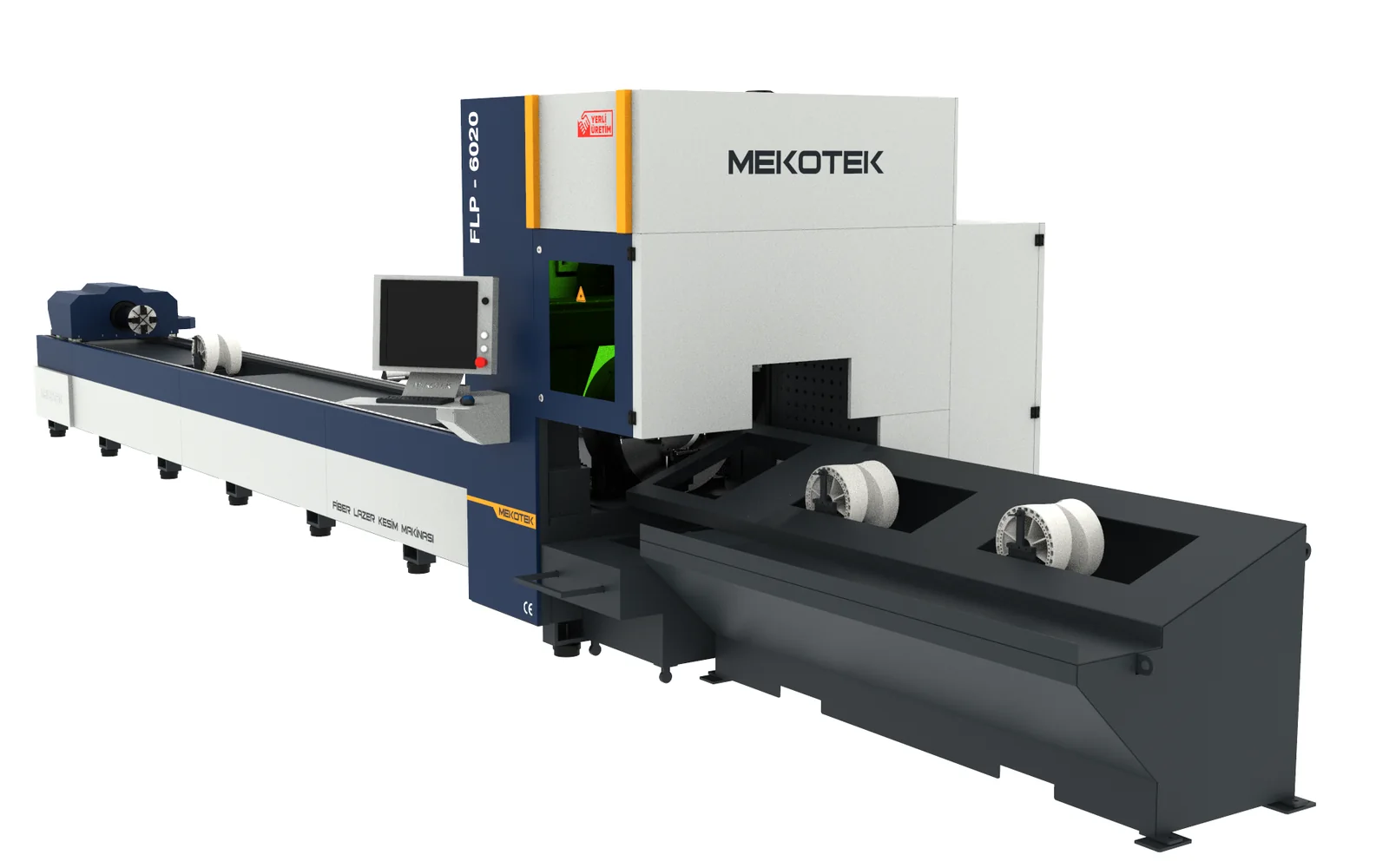
Loading. This is a variable that is easy to underweight. The dedicated tube and profile family spans manual loading, semi-automatic loading such as the FLP 6024 Semi Automatic, and full automatic bundle loading such as the FLP 6016, which feeds stock continuously so the cutting head spends less time waiting between bundles. For very long stock processed in a single setup rather than joined in sections, the FLP 9036 processes longer pipe lengths in one pass — check its published stock-length figure against your longest routine part before assuming a shorter-bed machine with a joining step is equivalent.
Match the loading method to shift pattern and volume, not to the headline capability of the cutting head: a manually loaded machine with ample diameter capacity can still bottleneck a high-volume operation on load and unload time alone.
Tight-tolerance features: separate the cutting tolerance from the assembly tolerance
A part with a tight-tolerance hole pattern, mating slot, or fitted joint raises a question distinct from thickness or material: is the tolerance the beam needs to hold, or is it the tolerance the downstream weld or assembly step needs from the cut part? The two are related but not identical.
- Confirm the positioning and repeatability figures published for the specific model, and check whether they were measured under the same conditions (material, thickness, feature size) as your part, rather than assuming a headline number transfers directly.
- Where the tight-tolerance feature exists to support a downstream weld or fit-up step — mating tube ends, bolt patterns, or press-fit features — evaluate the cut part against that downstream fit, not only against a dimensional inspection report.
- Run the actual feature, not a simplified test coupon, in any sample cut request. A round hole cut in isolation does not confirm how a complex nested feature or a small internal radius will perform on your material and thickness.
Mixed sheet-and-tube work: a scheduling decision more than a capability one
Shops that cut both flat parts and structural tube do not have to buy two separate machines. Combination configurations — the FLO-P and FLC-P models in the sheet and pipe family — add a rotary axis for tube and profile onto a sheet-cutting platform, so one system covers both part types.
The tradeoff is scheduling, not capability: a combination machine handles both part types but processes one at a time, and switching between sheet and tube modes costs setup time. Two questions decide whether that tradeoff works:
- How often does the shop need to switch between sheet and tube work within a single shift or day, and what does that changeover cost in practice?
- Is tube work a steady, high-volume stream on its own, or a real but intermittent part of the job mix?
Where tube volume is steady and high enough to run its own shift pattern, evaluating a dedicated tube machine such as those in the pipe and profile family alongside a dedicated sheet machine is worth comparing against one combination machine on total throughput, not just capital cost. Where tube is intermittent, a combination platform such as the FLO-P 2060 or an enclosed equivalent such as the FLC-P 1530 is the configuration built for that mix. Model the two busiest weeks of the year against both scenarios before deciding, since an average week understates the scheduling conflict.
Throughput bottlenecks that look like cutting problems but are not
Some of what feels like a capability gap is actually a handling gap: the laser sits idle while material is loaded or unloaded rather than because it cannot cut the part. On sheet work, dual-table configurations let one table load while the other cuts. On tube work, the loading ladder described above does the same job. Before concluding that a hard part needs more laser power or a different configuration, confirm how much of its current cycle time is actually spent cutting versus waiting for material handling.
Enclosure and the surrounding process
Sometimes the difficult part of a job is not the part geometry but the environment around it — fume from coated material, floor space constraints, noise, or access control in a shop with mixed operations nearby. This is where enclosed configurations differ meaningfully from open ones, and it is a planning decision to resolve before installation, since retrofitting enclosure and extraction around an already-installed open machine is a harder problem than specifying it up front.
Running the evaluation on your own parts
- Write the hard-part list: material, thickness, geometry, stock length, volume and current cost or outsourcing rate for each.
- Sort the list into sheet-only, tube-only, or genuinely mixed work. That sorting narrows the family before any model comparison starts.
- Check the published specification table for each candidate model against the biggest and thickest items on the list — read the table, not a marketing description of capability.
- Decide loading and table configuration from volume and shift pattern, not from a brochure's headline feature.
- Request sample cuts in the actual alloys, thicknesses, coatings and feature geometry the shop runs, and inspect them against production tolerance, not a demonstration standard.
- Confirm the supporting requirements alongside the machine itself: power, extraction, gas supply, floor space and material handling.
- Confirm service, spares and support arrangements directly with the supplier before finalizing a configuration.
Browse the full equipment range to see which family maps to the hard-part list, then book a demo and bring the difficult parts — those are the ones worth watching a machine cut before a purchase decision is made.
See the machines behind the article
Browse the full Mekotek product brochure, or book a live demo and watch a Mekotek fiber laser cut your own material.